Showing posts with label Study. Show all posts

Wednesday, May 12, 2010

Staged Accident Claims Up 46% in the States


The National Insurance Crime Bureau (NICB; I can already see Bruckheimer behind this) reports that "staged accident questionable claims", or QCs, grew a whopping 46% over the years 2007-2009 (probably due to the recession).

As proof that something is awry, BI (Bodily Injury) and PIP (Personal Injury Protection) claims have decreased.

Here's what the report revealed:

"The top five states that generated the most staged accident QCs were: (1) Florida, 3,006; (2) New York, 1,680; (3) California, 1,619; (4) Texas, 792; and (5) Illinois, 433.

The five cities that generated the most staged accident QCs were: (1) New York City, 1,304; (2) Tampa, 562; (3) Miami, 511; (4) Orlando, 422; and (5) Houston, 376."

For more ways on how to avoid (...or avoid getting busted for) these Questionable Claims, the NICB has made some public service announcements for your entertainment that you can check out here.

By Phil Alex

Tuesday, May 11, 2010

Average CO2 Emissions of New Cars in Europe Fall 12% in 6 Years


Average European new car CO2 emissions have fallen by around 12% since 2003, according to a new study from auto consultancy JATO Dynamics. The volume-weighted European new car average is now 145.9 g/km, almost 20 g/km less than 2003, when JATO began collating European CO2 emissions data.

In addition, the study finds that half of all new cars sold in the 21 European countries analyzed by JATO had official CO2 emissions of 140g/km or less, compared to only 23% in 2003.

"The pace of improvement is remarkable and shows just how rapidly the industry has reacted to environmental demands," said David Di Girolamo, Head of JATO Consult.

"In 2003, only 24% of the market achieved an average of 130g/km. This was 40% by 2007, 51% in 2008 and 69% last year, already ahead of the 2012 EU target. This achievement is even greater when set in the context of new cars becoming larger, safer and better equipped, as consumer demands reach ever higher," he added.

According to the report, the decline in new car CO2 emissions is due to three key factors:


1) Vehicle Developments - including more efficient petrol and diesel engines, hybrid powertrains, more sophisticated transmissions, low rolling-resistance tires, improved attention to detail, aerodynamics, stop-start technology and regenerative charging systems

2) Taxation – guiding demand towards these models and technologies CO2-based purchase and/or ownership taxes, in some countries have been introduced in tandem with higher taxes on fuel. Significant rises in fuel prices (due to global oil prices) continue to influence consumers' choice of vehicle.

3) Scrappage schemes – during late 2008 and 2009, scrappage schemes in a number of European countries have benefitted the purchase of smaller, more efficient cars, in some cases with customers directly incentivized towards cars with low CO2 emissions.

Even non-scrappage sales have seen a marked shift towards smaller cars, with the largest rise in B-segment vehicles, an effect of recessionary pressure on family budgets pushing many customers across Europe to consider fuel efficiency ahead of other factors, for the first time.

Di Girolamo added that the rate of improvement been increasing since 2007, through more low-CO2 technology and specific low-CO2 models on European roads.

"Looking at year-on-year trends, it appears that, if the current momentum can be maintained, 130g/km by 2015, as required by the EU legislation, is achievable," Di Girolamo concluded.

Source: JATO

Wednesday, November 18, 2009

New Study Says that Every GM Vehicle Sold in the States Costs Taxpayers $12,200 - In Theory...

It's 'bailout talk' time again as a new study that was conducted by Thomas D. Hopkins, a Professor of Economics at Rochester Institute of Technology, for the 362,000-member strong National Taxpayers Union (NTU), finds that the American taxpayer will have put up $12,200 for every GM vehicle, and $7,600 for every Chrysler, sold from the beginning of 2009 to the end of 2010. Together, the taxpayer subsidy for Chrysler and GM, will theoretically exceed $10,700 per vehicle sold.

But that's only if, and we repeat if, the two companies fail before 2011 and don't repay their government loans. That's a big 'IF', if you ask us, but anyway.

Hopkins came out with these figures by making guesstimates on the 2009 and 2010 combined yearly sales of GM (5.06 million vehicles total) and Chrysler (2.3 million units total) and then dividing the numbers with the loans received by the two automakers, including GMAC's bailout money as the company now provides financing services to both GM and Chrysler.

The professor says that the result is a GM/GMAC bailout of $61.5 billion ($52.9+$8.6), and $17.4 billion ($13.5+$3.9) for Chrysler/GMAC, which amounts to $12,200 for GM and $7,600 for Chrysler on a per vehicle basis.

Hopkins does note however that for each year of survival beyond 2010 and as long as no additional government loans are provided, the taxpayer burden per vehicle would decline.

"Of course one could adopt a more optimistic set of assumptions, developing a scenario in which this rescue turns out so successfully that most (but certainly not all) of the taxpayers' investment ultimately is returned, perhaps indeed with some profit," says Hopkins. "In that event, most of the taxpayer burden would disappear."

"But the plausibility of such rosy assumptions is not easy to defend. For starters, some $6.4 billion of the bailout funds, in the form of loans to the former (now bankrupt) GM and Chrysler, are not legal obligations of the newly-structured GM and Chrysler," Hopkins added.

Pete Sepp, NTU Vice President for Policy and Communications, was even more aggressive in his commentary about the report:

"Every time someone in your neighborhood drives home in a shiny new Chevy Silverado, remember that it cost American taxpayers more than $12,000," said Pete Sepp.

"Between this and GM's plan to payback their bailout debt with other taxpayer funds, I wonder if all those Americans without work right now could think of any better ways to spend that money. This is a play out of the Bernie Madoff ponzi scheme playbook, and would be the equivalent of paying your Master Card bill with your Visa."

Leaving aside the fact that the 'taxpayer burden' per vehicle is based on the assumption that neither company will pay back any loans and that they will both fail by 2011, the report also does not take into consideration any other factors whatsoever including the cost for taxpayers if both companies went bankrupt leaving tens of thousands of workers directly and indirectly employed by GM and Chrysler without a job.

Link: NTU


Tuesday, February 10, 2009

New Study Predicts Global Vehicle Sales Will Drop 13% in 2009

CSCOOPGlobal light vehicle sales could fall as much as 13% to an estimated total of 56.8 million units in 2009, according to a study released by R. L. Polk & Co, a Michigan-based firm that collects and interprets automotive data. The report forecasts that after experiencing a 17 percent drop in 2008, U.S. light vehicle sales are expected to decrease by another 19 percent in 2009 to a total of 10.7 million units split between 8.5 million units for consumer retail and 2.2 million units for the fleet market.

Polk's study find that while Western Europe is showing less volatility than the U.S. auto market, sales are still expected to shrink by 12% over 2008 to 13.5 million units in 2009. As for the Asian market, with the exclusion of Japan, Polk is forecasting 12.4 million units in 2009 compared to sales of 13.3 million units in 2008.

"As domestic automakers are hard at work on their respective turn-around plans, they have to estimate overall industry volume, individual market shares, and vehicle mix to project their revenue potential and align their global cost structure," said Lionel Yron, director of Consulting & Analytics at Polk. "With the inability to use rising home prices to generate liquidity and tighter lending rules, Polk sees the U.S. market stabilizing around 16 million units within 3 to 5 years depending on the efficiency of the government stimulus package," Yron added.

Source: Polk

Tuesday, July 15, 2008

Parking Prices Study: London and Sydney Top the List

If you happen to own a car and for any reason decide to rent a parking space in the centre of London or Sydney, rising gas prices will be the least of your worries. According to a recent study performed by Colliers International, a property consultancy, London is the most expensive place in the world to park your car - the City topped the list at $1,167 (600 or €733) a month with the West End in second place at $1,136 (584 or €714). In third spot is Sydney, Australia at $775 (A$825 or €486).

Surprisingly, three more Australian cities made the top ten list with Brisbane at number five and Perth at number eight –Melbourne is eleventh. The most high-priced area to park in Asia is Hong Kong which takes fourth place at $742 (€467) a month while midtown New York City is ranked fifth most expensive at $585 (€367).

In terms of daily parking costs, London’s City submarket tops the list at $68 (35 or €43) followed by Amsterdam, London’s West End submarket, Moscow and The Hague. The cheapest city to park in the world is Delhi at a mere $1.75 (€1.1) for the whole day! See the complete Top 25 list along with analytical data on parking prices around the world after the jump. -Continued


Source: Colliers International

Monday, July 14, 2008

America’s Top 10 Most Stolen Vehicles: Japanese Carmakers Top the List…

Even thieves seem to prefer Japanese vehicles over their American counterparts. According to the National Insurance Crime Bureau’s (NICB) theft report study that examines data reported to the National Crime Information Center (NCIC), the most reported stolen vehicle in 2007 in the States was the 1995 Honda Civic. The top-10 list comprises of 7 vehicles from Japanese carmakers and just three from the former “Big 3”–’97 Ford F-150, ’94 Chevy C/K 1500 and ’04 Dodge Ram.

On a side note, the FBI preliminary Uniform Crime Report (UCR) data reveals that motor vehicle theft in the U.S. is headed for an 8.9% decrease in 2007, with final data set to be released later this year. Follow the jump to see the complete list. -Continued

Most Stolen Vehicles in the U.S. in 2007

1. 1995 Honda Civic
2. 1991 Honda Accord
3. 1989 Toyota Camry
4.
1997 Ford F-150 Series Pick Up
5. 1994 Chevrolet C/K 1500 Pick Up
6. 1994 Acura Integra
7. 2004 Dodge Ram Pick Up
8. 1994 Nissan Sentra
9. 1988 Toyota Pickup
10. 2007 Toyota Corolla

Source: NICB

Thursday, June 19, 2008

UK Drivers Slow Down as Fuel Prices Rise

While our fellow Texans are reacting to rising fuel prices by leaving their gas tanks empty (see report here), in the UK drivers are slowing down on motorways to conserve fuel, according to a study performed by “Keepmoving”, a traffic information organization that monitors the speed of 230,000 vehicles fitted with sensors.

The study revealed that the average speed in free flow conditions on the M6 highway from Birmingham to Carlisle was seen to have experienced a 0.9% decrease in the first part of June 2008 compared to the same period in 2007 while the M25 was seen to have decreased by 0.3%. The organization said that whilst the decrease appears modest, it portrays a consistent picture across the UK where a cross-section of motorists are driving more slowly in order to conserve fuel. -Continued

As well as a reduction in speed, the study also found that congestion had fallen by up to 12% in the past month because there were fewer cars occupying Britain's roads.

Tuesday, November 20, 2007

EU: New CO2 Study Reveals That German Carmakers Are Off Course

A new study conducted by the European Federation of Transport and Environment shows that French, Italian and Japanese carmakers have extended their lead over German rivals last year in the race to deliver fuel efficient and low emission vehicles..

From the major car producing countries in Europe (only car groups that sold over 200,000 vehicles in Europe in 2006 were included in the study), in 2006 German groups increased new car emissions of carbon dioxide (CO2) by 0.6% on average compared to 2005 figures. On the other hand, French and Italian carmakers cut emissions by an average of 1.6%. -Continued after the jump

While BMW managed to reduce average emissions by 2.5%, the two largest German groups DaimlerChrysler (now called Daimler) and Volkswagen saw increases of 2.8% and 0.9% respectively.

Japanese car manufactures made significant progress in 2006, achieving 2.8% cuts on average with Toyota making the biggest improvement of any major car manufacturing group in 2006 with the average vehicle sold in 2006 emitting 5% less CO2 than the previous year.

PSA Peugeot Citroën (142 g/km), Fiat SpA (144 g/km) and Renault SA (147 g/km) sold Europe's lowest emitting cars in 2006 on average. Those companies took the top three places when ranked by average emissions of CO2 in grammes per kilometre. Toyota Motor Corp (153 g/km) and Honda Motor Company (154 g/km) took fourth and fifth place. DaimlerChrysler came bottom of the list of major carmakers with average emissions of 188 g/km.

Via: Motorpasion , Pic: Economist

Thursday, September 27, 2007

Toyota Prius Loosing Out In the "Green" Game To Conventional Cars - Or They Say

A new study conducted by researchers at Cardiff University and Clifford Thames finds that the Prius isn’t the greenest of them all. But how did they come to this conclusion? Well, Cardiff University and Clifford Thames researchers devised an environmental rating system for vehicles (ERV) which takes into account cars’ overall environmental footprint (including raw materials, production and end-of-life costs - based on their length, width and weight).

According to the study, in terms of high-volume "city" cars, the Citroen C1 and Toyota Aygo are among the best, with ERV scores exceeding that of the Toyota Prius hybrid. Someone might point out that the Prius is a C-segment vehicle so the comparison is unjust. True, but Richard Barber, Clifford Thames Strategy and Business Development director believes that conventional petrol and diesel cars will quickly outpace Toyota’s Prius on environmental friendliness. -Continued after the jump

"While the Prius is presently the best among vehicles its size, we are seeing advances in traditional powertrain technology that will help other vehicles close the gap or even leapfrog existing hybrid solutions", said Barber.

Even though I’m not much of a Prius fan, I’ll have to disagree with Mr. Barber for the simple reason that the Prius uses multiple propulsion systems to provide power. In other words, the Prius combines a gasoline engine and an electric motor. Therefore, all Toyota needs to do is add a more frugal and environmentally friendly gasoline engine, and it will furthermore increase the distance from its competitors

Links: Cardiff University & Clifford Thames

Monday, July 16, 2007

Acura, Saturn & Land Rover Dealerships Top Shopper Satisfaction Study

Acura dealerships received the highest ranking in a study conducted by Pied Piper that measures how well consumers are treated when shopping for a new vehicle. Following Acura were Land Rover, Saturn, Jaguar, Volkswagen and nineteen more brands that managed to be ranked at or above the indusrty average. On the… other side of the moon Pied Piper's study ranked 12 brands ranked below the industry average (in alphabetical order): Cadillac, Chevrolet, Chrysler, Ford, Isuzu, Jeep, Kia, Lincoln, Mazda, Mitsubishi, Scion and Suzuki. -Continued: Click “Read More…” below

According to Pied Piper, Acura dealers were ranked consistently among the top brands for most of the 50+ sales process aspects evaluated by the study, and ranked first for giving prospects compelling reasons to buy from their specific dealership. Other brands led the industry in different areas. Land Rover salespeople for example were most likely to provide a "walk-around" showcasing product features and benefits, and were also most likely to offer a brochure. Saturn salespeople were most likely to offer a test drive, and to provide compelling reasons to buy now. Jaguar salespeople were most likely to mention financing options. Lexus salespeople nearly always (98% of the time) asked for contact information while BMW salespeople were most likely to appear responsible for setting the sales price themselves.

Other interesting facts that we discovered in Pied Piper's dealership satisfaction study include: salespeople offered a test drive 89% of the time, asked for contact information 83% of the time, asked for the sale 75% of the time, offered a brochure 66% of the time and provided compelling reasons to buy from their specific dealership only 51% of the time.

Pied Piper's study was conducted between April 2007 and June 2007 using anonymous shopper evaluations at 1,592 dealerships located throughout the U.S., representing approximately one in fourteen of all U.S. light vehicle dealership locations.

Via: Pied Piper

Wednesday, January 3, 2007

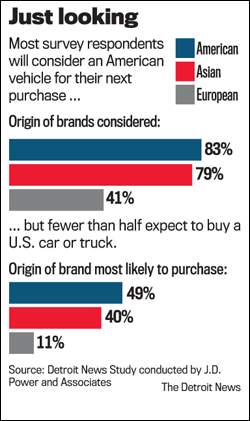
Survey: Why don’t Americans prefer domestic brands?

Japanese firms are dangerously closing up the sales gap between them and the domestic car-makers in the US market, but that’s something we all know. We all probably know the main reasons why: poor quality and reliability. Still though it’s very interesting to see what “ticks” American consumers.

And that’s exactly what J.D. Power and Associates
did as they conducted an exclusive study for The Detroit News providing answers to as why Americans avoid vehicles built by the former Big Three (General Motors., Ford Motor Co. and the Chrysler Group of DaimlerChrysler AG). Check it out by clicking the following link (PDF file): Detnews Survey

Technorati: Detnews, Survey, autos, auto+news, car+news, automobile, cars, automotive, vehicles, Carscoop, blogs